


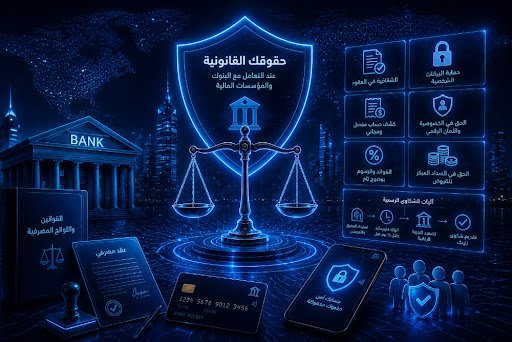
Your smart guide to protecting your money: Behind the scenes of your missing legal rights when dealing with banks
Discover your hidden legal rights when dealing with banks to protect your funds from unjustified fees, and learn practical, uncomplicated ways to manage financial institutions safely and smartly.
Have you ever opened your banking app to find a mysterious deduction of two or three dollars without any clear explanation? This happens daily to millions, and the issue isn’t the small amount itself, but rather the legal and intellectual rights that most of us overlook amidst the hustle and bustle of life and fast-paced transactions. The story always begins with that lengthy set of terms and conditions we sign without reading, thinking that once we sign, we’re completely at the mercy of the financial institution. This is absolutely untrue. From my experience in the market, I can say that banks fear the informed customer who knows their legal boundaries precisely and has the courage to discuss the details.
The mystery of terms and conditions that no one reads
The first battle begins at the customer service counter, where the employee smiles and hands you a stack of papers for a quick signature. This is where the biggest mistake lies. The law grants you the full right to request a complete copy of the contract and read it at home at least two days before signing. Interestingly, banks are obligated to provide a simple, clear, and concise summary, free of complex jargon, explaining the main obligations, interest rates, and how they are calculated. What we observe daily from our clients is an unjustified rush, driven by a fear of wasting time. But hold on! These documents are your only defense in case of any future dispute. Therefore, you must uphold your legal rights when dealing with banks by fully understanding every line and every clause before placing your final signature

Mysterious bills and the silent discount war
Transparency in transactions is not a luxury chosen by financial institutions, but a strict legal obligation imposed by central banks in most countries. You have the right to receive a free, detailed periodic statement outlining every transaction, both incoming and outgoing, in meticulous detail. Herein lies the most important advice for ensuring your financial security: the necessity of tracking small bank fees that silently drain your account to know exactly where your money goes each month. Some institutions may impose administrative fees under strange names, such as system maintenance fees or data update fees. These are prohibited by law without prior written notification at least thirty days in advance. Always remember that remaining silent about small deductions legitimizes their continuation.
Protecting personal data is more than just a password.
In the age of digital transformation, your financial data has become a huge asset that companies compete to acquire. This is where the law intervenes strongly to protect you. Your bank does not have the right to share your phone number, email address, or the nature of your expenses with any external marketing entity without your explicit written consent. This leads us to digital security, where modern financial legislation requires all banks to provide advanced protection systems and secure applications. If your account is hacked or subjected to external fraud due to weaknesses in the bank’s security systems, the law is on your side and obligates the institution to compensate you for the losses in full, provided that you report immediately within twenty-four hours of receiving the suspicious debit message.
The Behind-the-Scenes of Loans, Finance, and Variable Interest Rates: Your Legal Rights When Dealing with Banks
Falling into debt due to a lack of understanding of how interest is calculated is the worst-case scenario we frequently observe in the market. The law requires financial institutions to explain the difference between fixed and variable interest rates clearly and concisely, using real figures. You should learn how to interpret hidden clauses in personal loan contracts without legal counsel to avoid future surprises related to interest rate changes in line with central bank decisions. Furthermore, you have the legal right to repay your loan early at any time to reduce the total accrued interest. Financial institutions cannot prevent you from doing so; in fact, the law mandates that they accept repayment with a very small early repayment penalty, predetermined by the central bank and not left to the whims of commercial banks.
I believe that current banking laws provide excellent protection for customers, but the real gap lies in consumer laziness in seeking knowledge and banks' deliberate insistence on presenting information in a complex and vague manner.
Official complaint mechanisms: Where to go when the bank refuses to listen to you
In the age of digital transformation, your financial data has become a huge asset that companies compete to acquire. This is where the law intervenes strongly to protect you. Your bank does not have the right to share your phone number, email address, or the nature of your expenses with any external marketing entity without your explicit written consent. This leads us to digital security, where modern financial legislation requires all banks to provide advanced protection systems and secure applications. If your account is hacked or subjected to external fraud due to weaknesses in the bank’s security systems, the law is on your side and obligates the institution to compensate you for the losses in full, provided that you report immediately within twenty-four hours of receiving the suspicious debit message.